
Buying a car is one of the more consequential consumer decisions most people make. It is expensive, often urgent, and increasingly complex. And yet, for all the time and attention people devote to it, the process itself remains oddly unstructured.
Most buyers begin the same way: by gathering information. They read reviews, watch videos, browse listings, and narrow their options to a handful of vehicles that seem to fit. At that point, they go see them in person, maybe test drive two or three, and then—somewhere in the middle of that experience—the decision starts to take shape.
Not as a formal conclusion, but as a feeling. A sense that one of these is “the one.”
There is nothing inherently wrong with that. But it is a surprisingly fragile way to make a decision that can easily reach $50,000 or more and will shape your daily experience for years.
The issue is not that people lack information. If anything, the opposite is true. There is an overwhelming amount of content about cars—spec sheets, rankings, expert opinions, owner forums—each offering a different lens. What’s missing is not more data, but a way to organize it into something coherent and personally meaningful.
And, more fundamentally, there is an expectation baked into the process that most people quietly accept:
That in order to make a good decision, you need to become something close to an expert.
You shouldn’t have to.
Because the real decision is not between a good car and a bad one. It is almost always between several good options that make different tradeoffs.
One vehicle might offer a smoother ride and a quieter cabin, but feel less engaging to drive. Another might be more efficient but less spacious. A third might have a beautifully designed interior paired with a technology interface that is frustrating to use. None of these are disqualifying flaws. They are characteristics. The challenge is understanding how those characteristics align with your priorities.
And that alignment is rarely made explicit.
Over time, in writing and thinking about cars through Autolitics, I found myself returning to the same idea: that cars should be evaluated not just as objects, but as products—systems that combine design, engineering, and user experience into something that unfolds over time. When you take that view, the gaps in the typical buying process become more obvious. People are being asked to make a complex, multi-variable decision without a clear framework for doing so.
Autolitics Studio grew out of that observation.
The goal was not to create another source of opinions, or another set of rankings, but to introduce structure into the decision itself. To make it possible for someone to move from a broad set of impressions to a clear understanding of which vehicle actually fits their needs, and why—without requiring them to develop deep domain expertise along the way.
In practice, that means slowing the process down just enough to make it deliberate. It means defining what matters at the outset—not in vague terms, but in concrete ones tied to how the vehicle will be used. It means evaluating each option across the dimensions that shape the ownership experience: how it drives, how it feels inside, how its technology works in everyday use, how it manages space, efficiency, and cost. And it means comparing those evaluations consistently, so that differences become visible rather than intuitive.
What tends to emerge from that process is not a dramatic revelation, but something quieter and more useful: clarity. The sense that one option is better aligned than the others, not because it wins on every dimension, but because it fits the overall picture more convincingly.
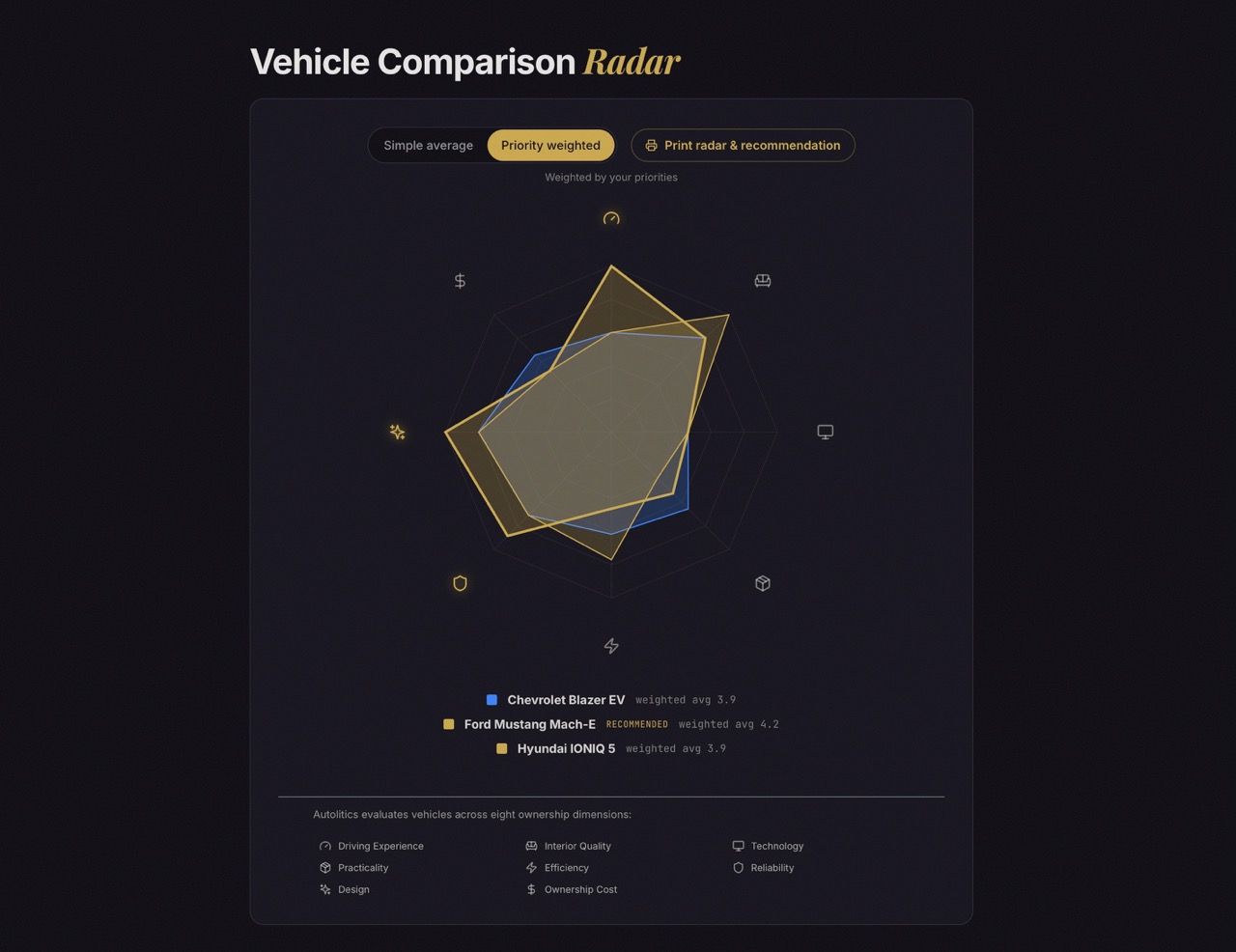
Structured comparison makes tradeoffs visible and decisions clearer.
At the center of Studio is a set of tools designed to support that clarity. Not by overwhelming the user with more data, but by organizing the decision in a way that reflects how people actually experience a car over time.
The comparison system, for example, allows vehicles to be evaluated across a consistent set of dimensions and then visualized in a way that makes strengths, weaknesses, and overall balance immediately apparent. It is not about assigning a definitive “score,” but about making tradeoffs legible.
Similarly, the evaluation process itself is structured so that test drives become more than quick impressions. Instead of trying to remember how each car felt in isolation, you capture observations in a way that can be compared later—when the differences actually matter.
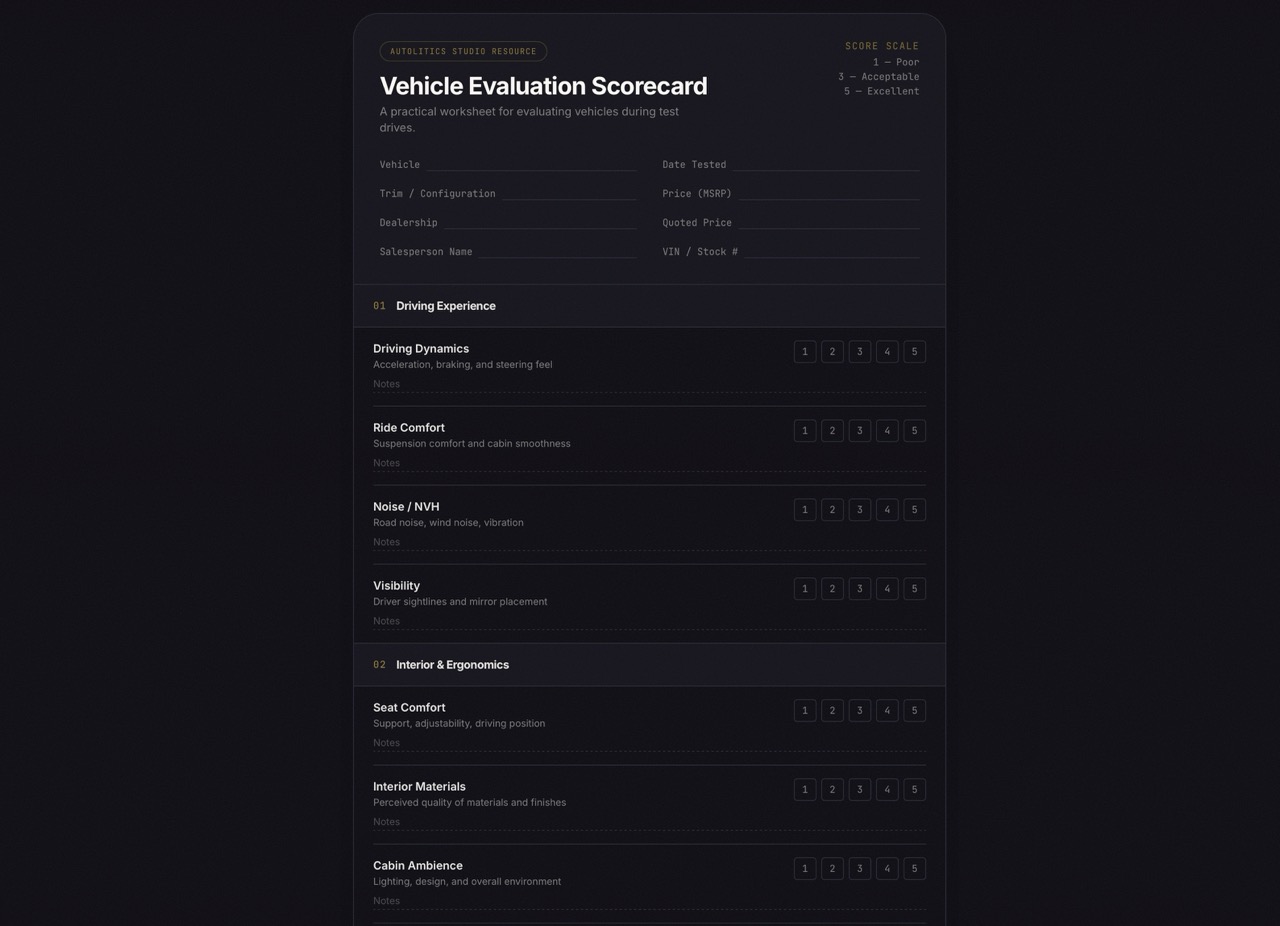
Simple tools, used together, turn a subjective process into a structured one.
There are also more practical layers to the process that tend to be opaque to most buyers: how pricing actually works, how to evaluate competing offers, how to avoid paying for things that don’t add value. These are not separate from the decision—they are part of it—and they benefit from the same kind of structure.
For some, the tools and framework are sufficient. For others, there is also the option of a more hands-on advisory experience, where I work directly with clients to help narrow options, evaluate tradeoffs, and navigate pricing and negotiation. But the core of Studio is not the service layer. It is the method itself.
There is a tendency in the car market to search for certainty in external signals—rankings, consensus opinions, what is considered “the best.” Those signals have their place, but they are not a substitute for a well-structured decision. The right car is not the one that wins in general. It is the one that makes the most sense in context.
Autolitics Studio is an attempt to make that context visible, and to give buyers a clearer path through a process that is often more opaque than it needs to be.
If you’re in the market, or expect to be soon, you can explore it here: